Hand-Eye Calibration Residuals
In order to evaluate the performance of the hand-eye calibration, it is typical to have a method to check the residuals. Here we explain what hand-eye calibration residuals represent and how to read them.
데이터 세트에 있는 각 캘리브레이션 객체 포인트 클라우드에 대해 일정 개수의 특징점이 추출됩니다. 이 특징점들의 모음을 특징점 집합이라고 부르겠습니다.
With the result of hand-eye calibration, it is possible to compute a coordinate transformation. This coordinate transformation brings each capture’s feature point set from the camera coordinate frame into a common frame, the frame in which the calibration object is stationary. For eye-in-hand this is the robot base frame; for eye-to-hand it is the robot end-effector frame, that is the flange or the TCP.
Assume that each element of the robotic system, i.e. camera, robot, and hand-eye calibration algorithm was perfect. Then feature points from one transformed set would have the same coordinates as their counterparts from the other sets in the dataset. Visually, this means that all the feature point sets in 3D space would overlap. This is never the case in reality and there are always some residuals. Visually, this means that the same feature points from different sets don’t fully overlap.
Reference sets
The residuals are not measured between captures directly. Instead, each capture is compared against a reference feature set derived from the other captures, so the capture being scored never helps define the reference it is measured against. Zivid software estimates the pose of each capture’s feature point set and of its reference set. The residuals are then the relative position and orientation between the two.
If you provide the calibration object’s known placement for low-DOF calibration and it gives a position for every feature point, that fixed geometry is used as the reference instead, and each capture is compared against it rather than against the other captures. This is the case for a board placement given as a pose, and for fixed marker positions. A board placement given only as the position of its origin does not locate every feature point, so the reference is still derived from the other captures.
Calibration board
When the calibration object is a Zivid calibration board, every capture yields the same grid of feature points.

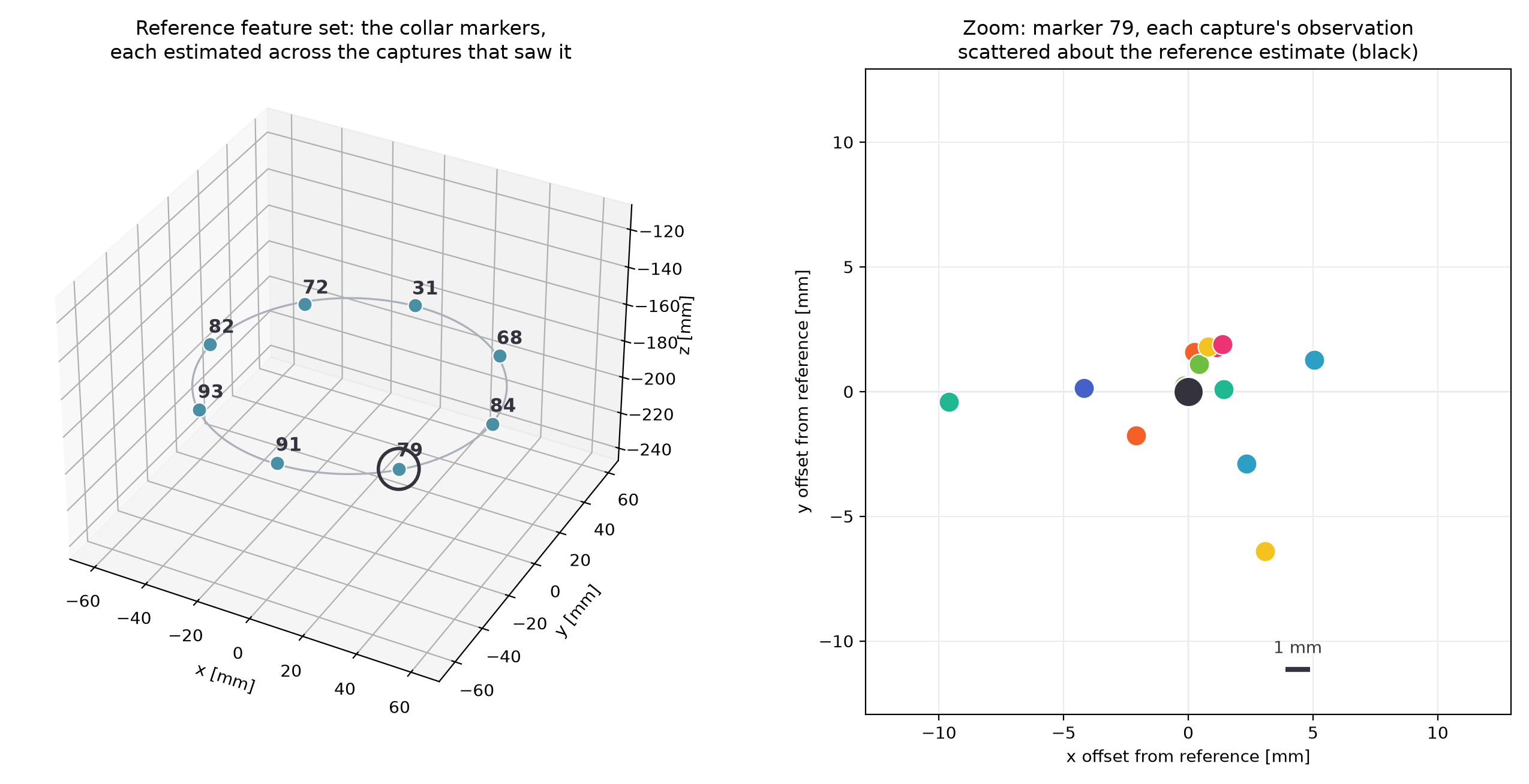
Each feature point of the reference set is the average of that feature across the other captures, shown as the black enlarged sphere in the zoomed-in view.

Fiducial markers
The same reference-set idea applies when the calibration object is a set of fiducial markers instead of a board. Only the feature points differ. Each detected marker contributes a single feature point. A marker that is not detected in a given capture contributes no point for that capture.
This matters whenever the markers are spread out so that no single capture sees all of them, for example a layout wrapped around a flange or a collar. Each capture then sees a different, and sometimes disjoint, subset of the markers.
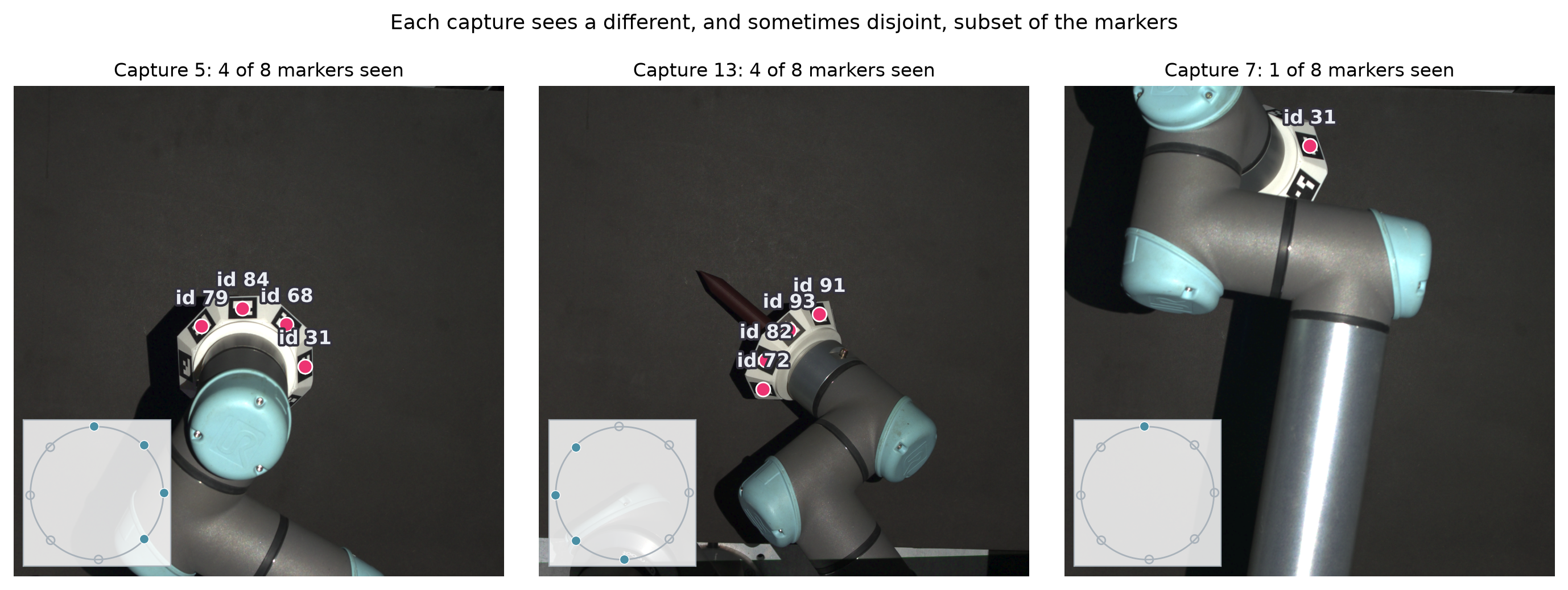
A reference feature set is still derived from the other captures, and each capture is compared against it. The reference set spans all the markers, even though no single capture saw them all, and each capture is compared against it on the markers they have in common.
Translation residual
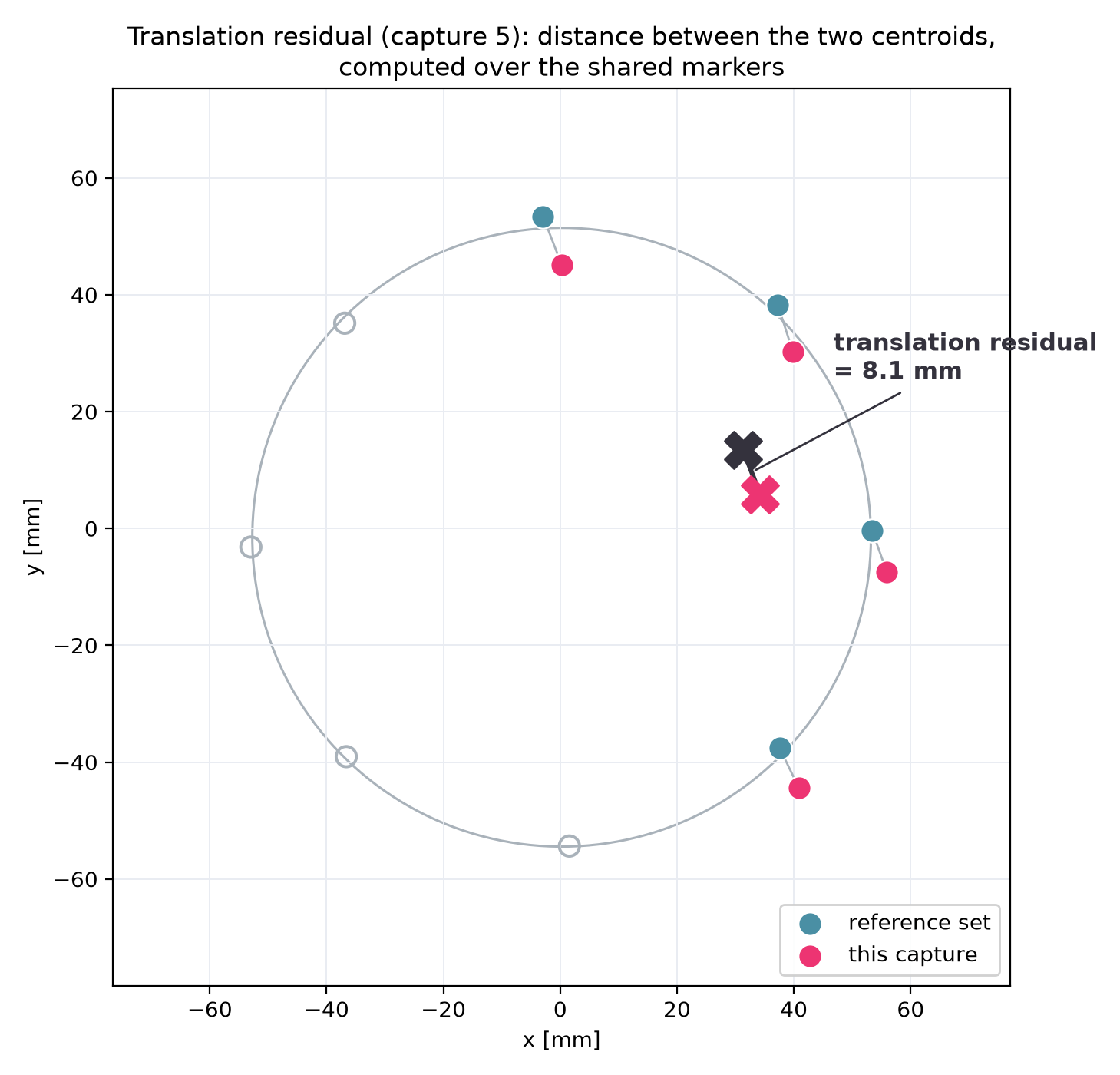
The translational residual is the distance between the reference frames that represent the capture’s feature point set and the reference set.
Because it compares the two frames through their centroids, the translation residual lets opposing per-feature errors cancel.
A feature that is too far in one direction can be offset by another that is too far in the opposite direction, leaving the centroid distance small; a small rotation about the centroid is the simplest example.
A complementary per-capture figure, Calibration::HandEyeResidual::pointRMSE, avoids this: it is the root-mean-square of the per-feature distances between the reference and the capture, taken over the features they share.
These per-feature distances do not cancel, so it is the more faithful answer to how far each feature lands from its reference, in millimeters.
Treat it as a complementary per-capture accuracy figure, not a threshold.
Calibration board
With a board, every capture shares the same grid of feature points. The two frames are placed on that same set of points, and the distance between them is the translation residual.
Fiducial markers
With markers, the residual is the distance between the centroids of the reference set and the capture, taken over the markers they share, so it is well defined even when captures see different, or disjoint, subsets of the markers.
Rotational residual
The rotational residual is the angle of the angle-axis representation of the rotation between a capture’s feature point set and the reference set.
A rotation is only defined when the feature points constrain all three axes. This requires at least three non-collinear feature correspondences.
The angle carries no scale on its own.
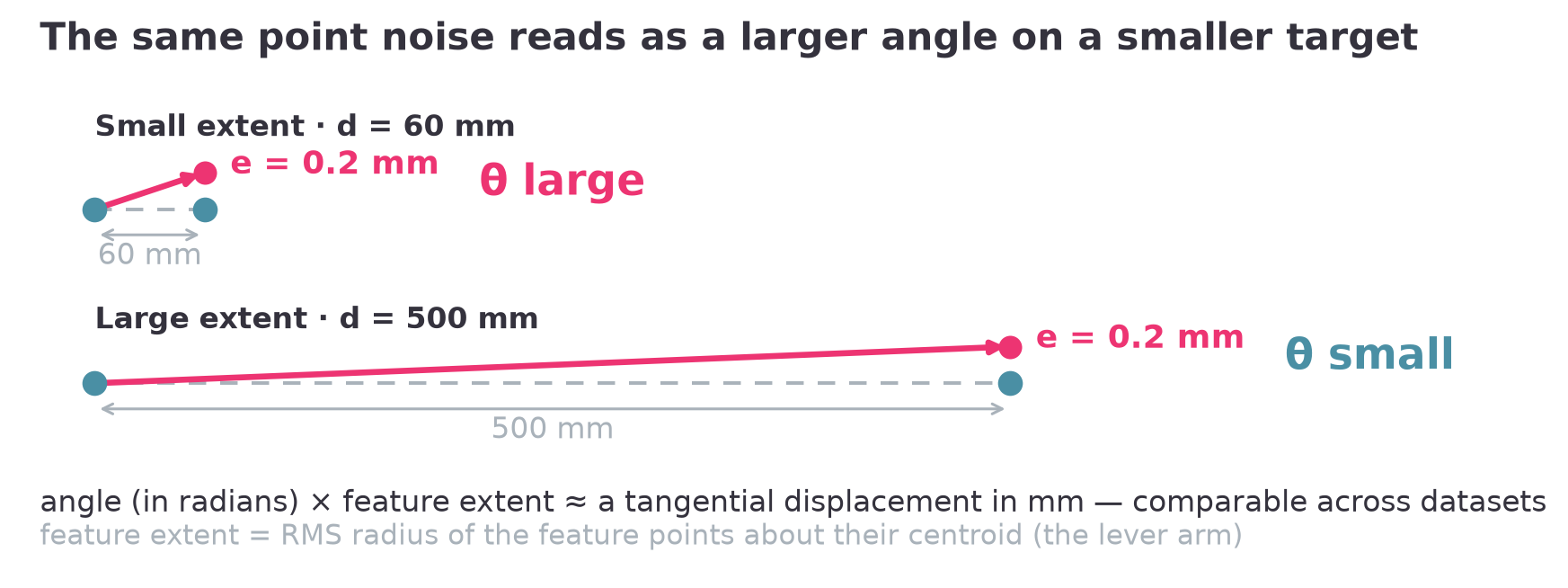
For point noise e over a feature layout of extent d, the fitted angle is roughly e / d.
The same point noise reads as a larger angle on a small target and a smaller angle on a large one.
Here the point noise is the residual scatter of the feature points after calibration.
It is related to, but not the same as, the camera’s point precision, and should not be read as a camera precision figure.
To interpret the angle, we introduce the feature spatial extent as a lever arm. It is the RMS radius of the feature points about their centroid, shown here as the circle on a real set of collar markers.
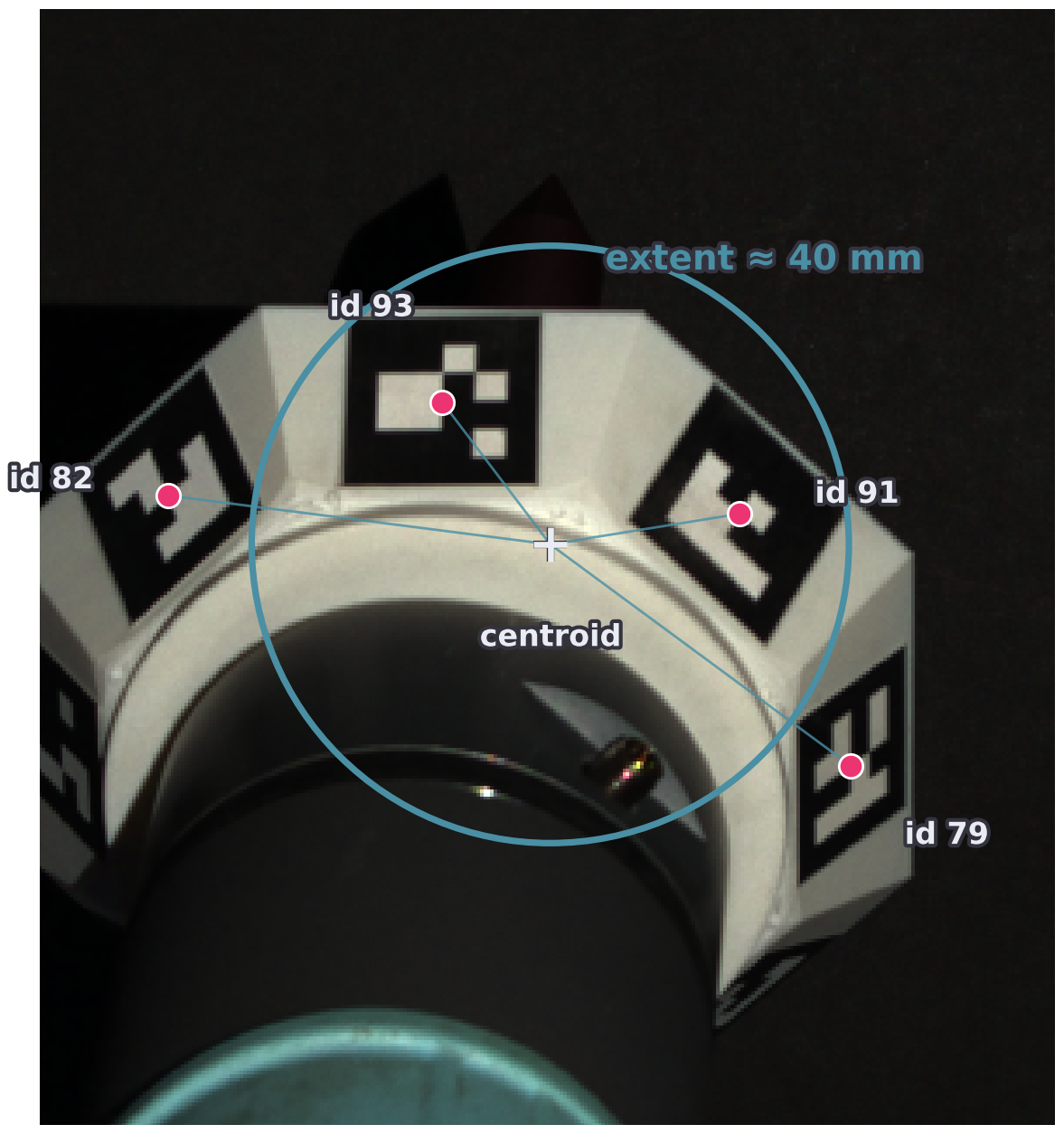
The product of the angle, converted to radians, and the extent is approximately a tangential displacement in millimeters. This displacement is comparable across datasets, and comparable to the translation residual.
Treat the scaled rotational residual as an interpretation aid and a lower bound. It is not an accuracy figure and not a published threshold.
Calibration board
A board always provides many non-collinear feature points across its surface. The rotational residual is therefore well defined for every capture, and the spatial extent is set by the size of the board.
Fiducial markers
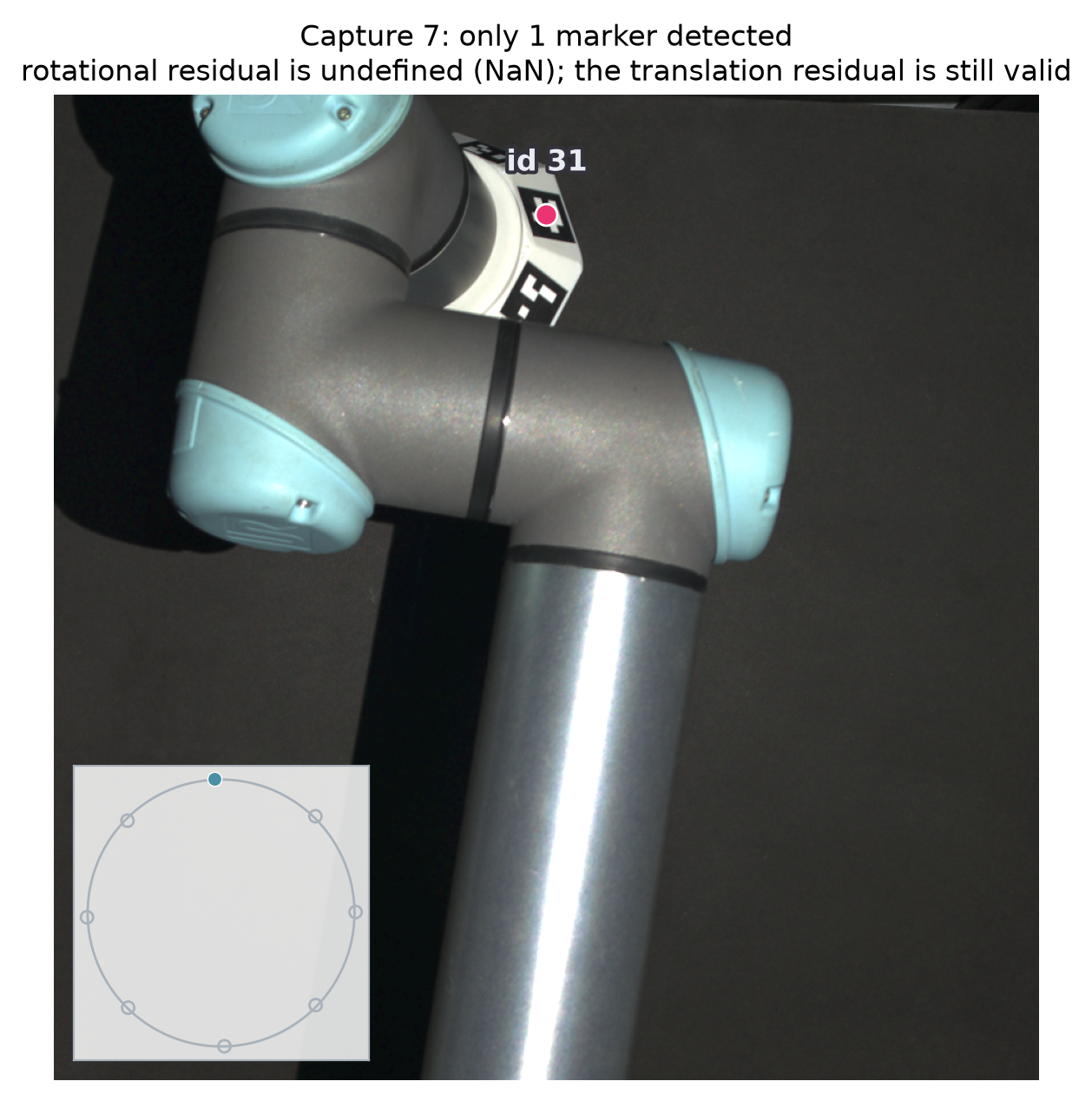
With only one or two markers the rotational residual is reported as NaN, meaning undefined. The translation residual is still valid in this case. A single marker centre, or a set of collinear centres, cannot pin an orientation.
참고
There is also an observability caveat, and it concerns the dataset as a whole rather than the individual capture. Hand-eye calibration only constrains rotation axes that the robot actually rotates about. When every pose in the dataset shares a single rotation axis, as is unavoidable in a low-degree-of-freedom setup, the two orthogonal axes are never exercised and stay unobserved. The rotational residual then reflects only the exercised axis: it can be reassuringly small while saying nothing about the accuracy of the unexercised axes, even when every capture has three or more feature points.
Reading the residuals
No single number certifies a calibration, so read the residuals together and relative to each other rather than against a fixed cutoff. The residuals measure how consistent the dataset is with itself, not absolute accuracy against the robot or the world, so they are a relative quality signal.
Compare captures within one dataset: the capture whose translation or point RMSE stands out from the rest is the one to re-inspect or re-take. Prefer the point RMSE over the translation residual for per-capture accuracy, because the centroid distance can stay small while individual features are far off; a small translation residual alongside a larger point RMSE is that warning sign.
Scale the rotational residual by the feature extent before comparing it, so it reads as a displacement in millimeters that is comparable across datasets and against the translation residual. A larger spatial extent makes the same rotational accuracy easier to reach, so compare rotational residuals taken at a similar extent.
이것으로 핸드-아이 캘리브레이션 이론에 대한 글을 마치겠습니다. Zivid 소프트웨어를 사용하여 핸드-아이 캘리브레이션을 수행하는 방법에 대한 실습 튜토리얼은 Zivid 캘리브레이션 객체 선택 방법 .
Version History
SDK |
Changes |
|---|---|
2.19.0 |
Spatial extent and point RMSE are added, and the page now covers fiducial markers, the rotational residual, and how to read the residuals. |