多相机标定的理论
The Multi-Camera Calibration article focused on the practicalities of Multi-Camera Calibration. This article explains the transformation-matrix math behind it.
标定对象
用于多台相机标定的标定对象必须满足可以准确地确定其相对于相机的位姿(位置和方向)。
变换矩阵
组合了旋转和平移的矩阵,可使用该矩阵通过矩阵乘法将一个坐标系中的位置矢量转换到另一坐标系。
两台相机之间的转换
考虑使用两台相机的场景。
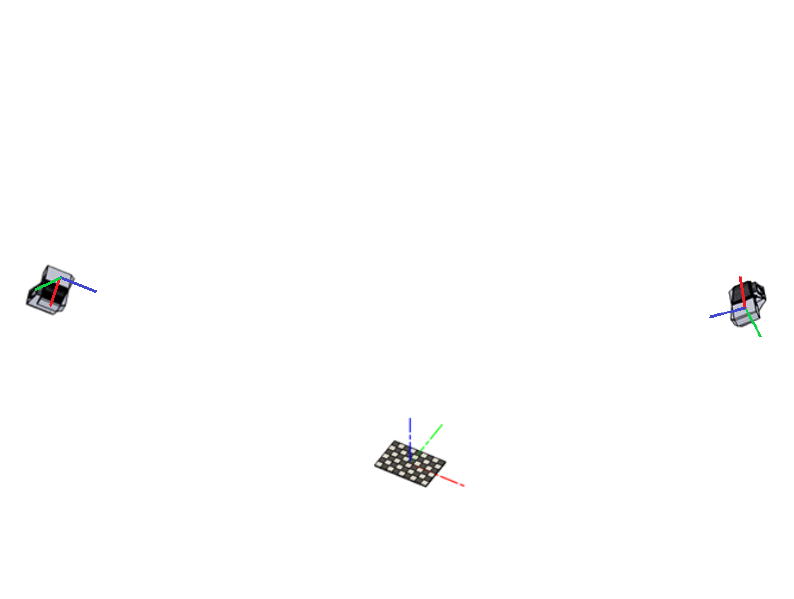
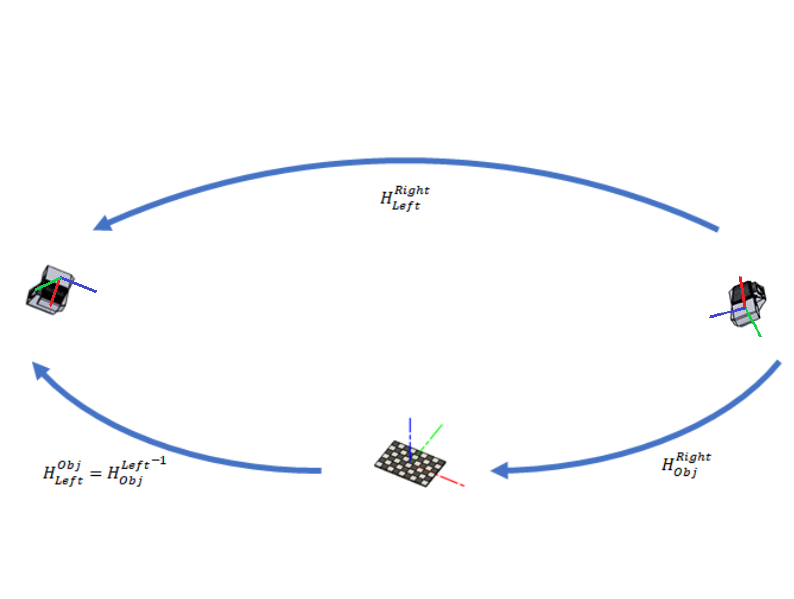
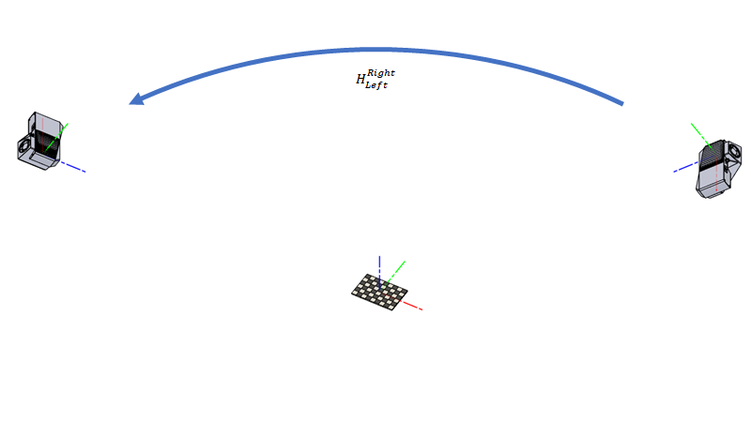
我们想找到描述了从右侧相机转换到左侧相机坐标系的变换矩阵 \(H^{Right}_{Left}\) 。
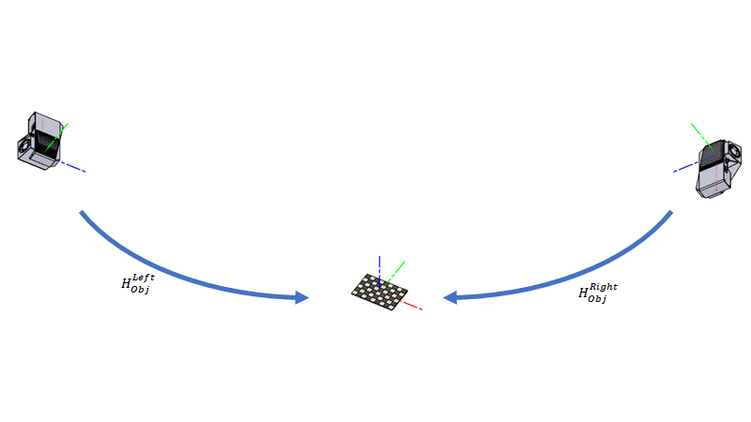
但是,我们从每个相机获得的数据都是标定对象在该相机参考坐标系中的位姿, \(H^{Obj}_{Left}\) 和 \(H^{Obj}_{Right}\)。这些位姿的倒数,(eq. 1) 和 (eq. 2),允许将点云中的点转换到标定对象的坐标系。
\[(H^{Obj}_{Left})^{-1} = H_{Obj}^{Left} \qquad (1)\]
\[(H^{Obj}_{Right})^{-1} = H_{Obj}^{Right} \qquad (2)\]
We could have stopped there, and provided transformation matrices to the calibration object, as a final result. We do not want to have a dependency on the pose of the calibration object, as that is often arbitrary. Thus we want \(H_{Left}^{Right}\) (eq. 3), whose inverse is \(H^{Left}_{Right}\).
\[H_{Left}^{Right} = H_{Obj}^{Right} * H_{Left}^{Obj} = H_{Obj}^{Right} * (H_{Obj}^{Left})^{-1} \qquad (3)\]